For most of the past few years, the story of India's electronics exports has been a story about smartphones. The latest numbers from the Ministry of Commerce & Industry suggest that story is changing, and the change runs deeper than phones alone.
In the first half of FY27 (April–September), India's electronic goods exports rose 44 per cent year-on-year to $31.97 billion, compared with $22.2 billion in the same period of FY26. The more telling detail is where the growth came from.
Smartphone exports climbed 35.8 per cent to $18.17 billion, up from $13.38 billion. Phones remain the single largest component of India's electronics exports. Even so, their share of the total fell from 60.3 per cent to 56.8 per cent, because other segments grew faster.
Non-smartphone electronics grew 56.5 per cent to $13.79 billion, up from $8.81 billion a year ago. The ministry said that, as a result, the share of non-smartphone electronics in total electronic goods exports rose from 39.7 per cent to 43.2 per cent, "indicating a broadening of India's electronics export basket."
This matters because an export basket that depends on one product is exposed to that product's demand cycles, to the decisions of a few global brands, and to trade policy shocks. A broader mix spreads that risk across more products and buyers.
The component surge
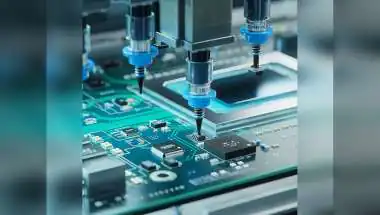
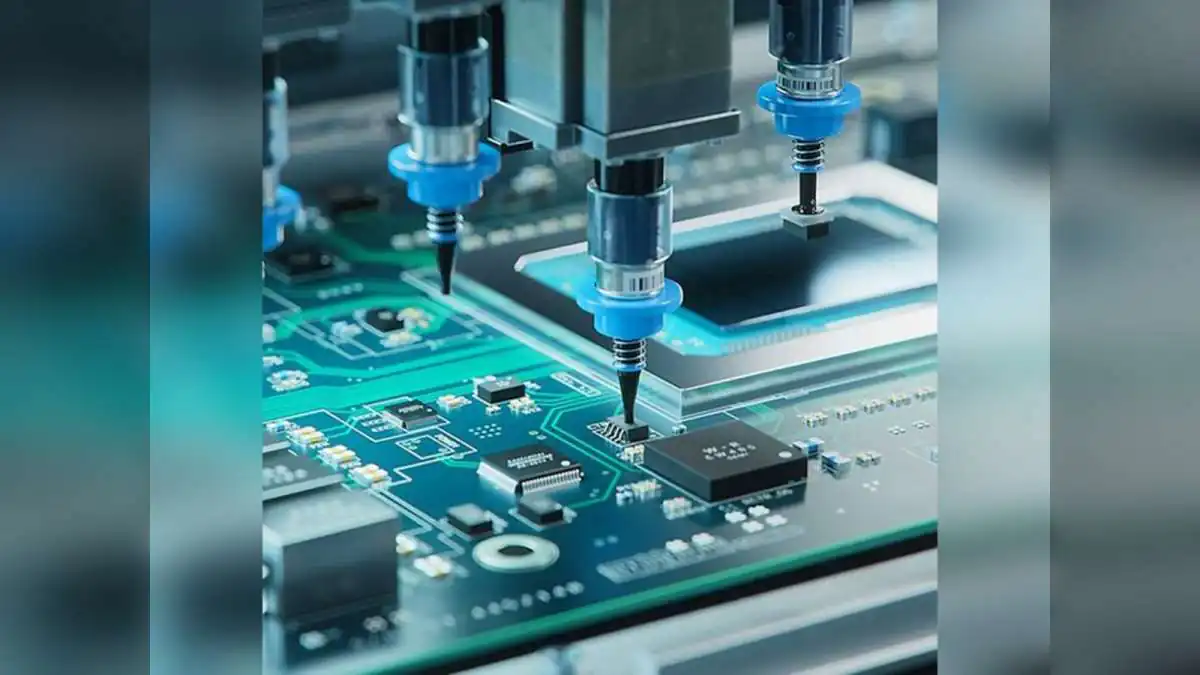
The steepest growth is in categories that sit deeper in the supply chain. Exports of parts and accessories with mounted printed circuit boards rose from $63.3 million to $2.10 billion, a jump of 3,219 per cent. Singapore was the top destination at $1.87 billion, followed by China at $111.5 million.
Exports of populated, loaded or stuffed printed circuit boards grew 304 per cent to $864.1 million, from $213.7 million. China was the leading market at $789.2 million, and shipments to Hong Kong rose to $25.3 million from $5.9 million.
The growth also reached networking and memory products:
- Exports of network transmission and routing equipment nearly doubled, to $1.45 billion.
- Exports of memory integrated circuits grew 2,333 per cent to $562.4 million.
- Exports of solid-state non-volatile storage devices rose 1,680 per cent to $260.5 million. China led at $108.6 million, followed by Singapore ($76.8 million), Hong Kong ($22.3 million) and the United States ($20.7 million).
Some of these percentages come from small starting values, so they will likely level off. What stands out is the pattern: India is now shipping more of the parts that go into finished devices, not only the finished devices.
Why the China figures stand out
China appears as a major buyer of Indian PCBs and storage devices. That suggests Indian manufacturing is being built into regional supply chains as a supplier, and not only as a final assembly point for products sold in Western markets. For an industry that has long relied on imported components, this is a notable reversal.
What comes next
The next test is whether the non-smartphone segments keep growing once these high growth rates settle. A rising share of components, memory and networking hardware would point to more value being added within India. That is the kind of manufacturing depth that policymakers and industry have been aiming for.
For now, the first-half data supports one clear conclusion: India's electronics exports are no longer just a smartphone story.
With inputs from IANS