For decades, infrastructure in India has meant highways, ports, railways and power plants. Finance Minister Nirmala Sitharaman on Saturday pointed to a different kind of foundation for the next phase. She said the next large investments in India's infrastructure must focus heavily on artificial intelligence, semiconductor chips and quantum computing.
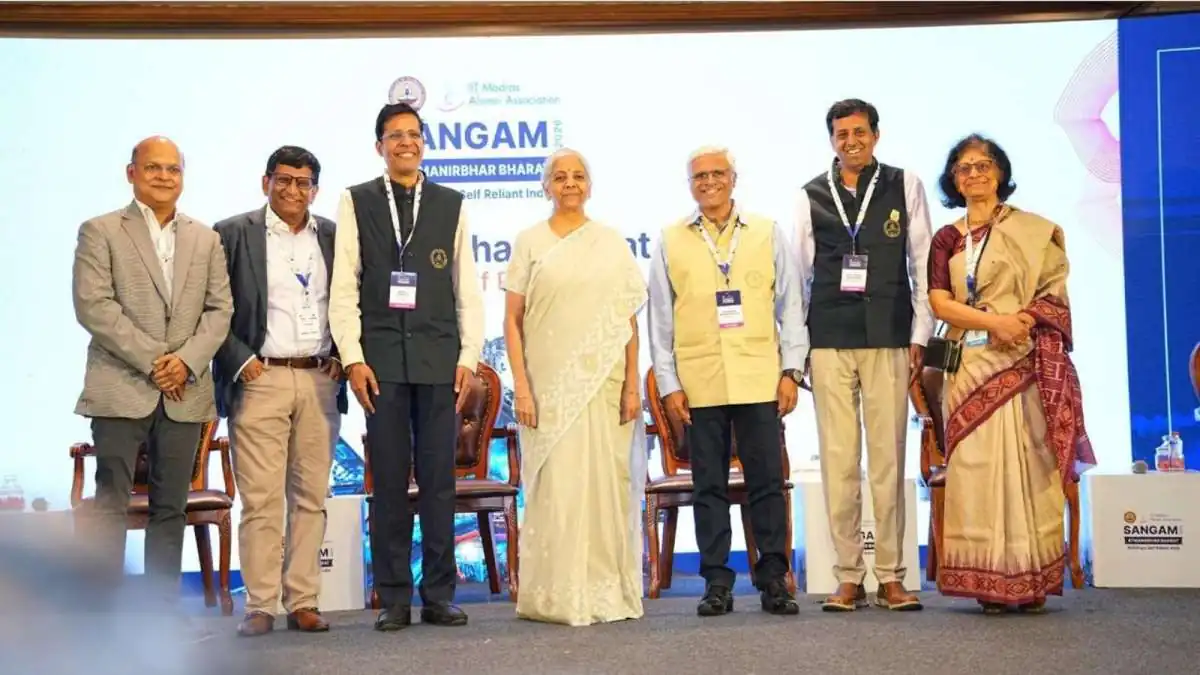
Addressing the 7th edition of IITMAA Sangam, the flagship annual conference of the IIT Madras Alumni Association in Bengaluru, she said technology and innovation must reach every sector of the economy, including agriculture, renewable energy and advanced manufacturing.
"India's transformation has been driven by sustained efforts to strengthen institutions, restore confidence and open sectors to private participation, while creating policies that enable young people, entrepreneurs and innovators to contribute to economic growth," Sitharaman said.
She pointed to the space sector as an example, noting that Indian startups are now designing and building satellites and undertaking space missions after the sector was opened to private players.
A Push for AI in MSMEs
A key part of her message was aimed at small businesses. "Our MSMEs, which produce everything from basic components to aircraft parts, need AI solutions to improve productivity and compete globally," she said, adding that technology-led growth would need greater collaboration across sectors.
The Deep-Tech Funding Gap
Sitharaman also stressed the need for patient capital and new early-stage funding mechanisms for pre-revenue deep-tech and hardware startups. Such companies often need years of research and development before they earn revenue, which makes them harder to fund through conventional venture capital.
She said IIT Madras' initiative to create a fund to support startups shows how academia, industry and government can work together to back innovation and entrepreneurship.
Why It Matters: The Building Blocks Are Already in Place
The Finance Minister's remarks build on missions the government has already launched in each of the three areas she named.
Semiconductors: The Union Cabinet approved the India Semiconductor Mission in 2021 with an outlay of ₹76,000 crore to boost fabrication, design and manufacturing. By August 2025, approved projects under the mission had reached 10, with cumulative investments of around ₹1.60 lakh crore across six states.
Artificial intelligence: The government approved the IndiaAI Mission on March 7, 2024, with a total outlay of ₹10,371.92 crore. From an initial target of 10,000 GPUs, the mission has since expanded India's computing infrastructure to 38,000 GPUs.
Quantum computing: The National Quantum Mission was approved in 2023, with a focus on quantum computing, communication, sensing and materials.
Her call for these sectors to anchor the "next large investments" signals that the government sees them not as niche technology bets, but as core national infrastructure, much like roads and power once were.
The 10% Question
Sitharaman said India can achieve more than 10% GDP growth, but this would require greater effort across all sectors and sustained collaboration to turn talent, technology and innovation into economic growth.
The link she drew is clear: without broad-based technology adoption, especially among MSMEs that form the backbone of manufacturing, double-digit growth would be hard to sustain.
Who Was at IITMAA Sangam
The conference, themed "Atmanirbhar Bharat – Building a Self-Reliant India", brought together policymakers, corporate leaders, technology pioneers, academics, startups and experts to discuss the drivers of India's strategic and economic self-reliance.
The event was inaugurated by Minister Pralhad Joshi, along with Vice Admiral Sanjay Sadhu, Controller of Warship Production and Acquisition, Indian Navy; Prof V Kamakoti, Director, IIT Madras; Dr Sridhar Vembu, Chief Scientist and Co-founder, Zoho Corporation; Goda Ramkumar, Vice President, Data Science, Flipkart; Prof M Vidyasagar, FRS; and Dr Pratyush Kumar, Co-founder, Sarvam AI, among others.
The Bottom Line
The message from Bengaluru was that India's future infrastructure will be measured not only in kilometres of road but in chips made, AI models built and quantum systems developed. Whether that vision reaches the country's small manufacturers, and whether deep-tech startups get the patient capital they need, will decide how quickly it translates into growth.
With inputs from IANS.