The Unified Payments Interface, operated by the National Payments Corporation of India (NPCI), is the world's largest retail fast-payment system by transaction volume, according to an IMF report. Now, a decade after its launch, India is asking some merchants to pay for it, to make sure the system is sustainable over the long run.
An article in the South China Morning Post describes UPI as having anchored a digital revolution in India, helping bring large sections of the population into the formal economy and becoming the backbone of a digital economy where electronic payments are central to everyday commerce.
In FY2025-26 alone, UPI processed about 24,162 crore transactions worth ₹314.23 lakh crore. The pace has only picked up since. In August 2026, the network processed 2,451 crore transactions valued at ₹29.9 lakh crore.
What Changes From October 15
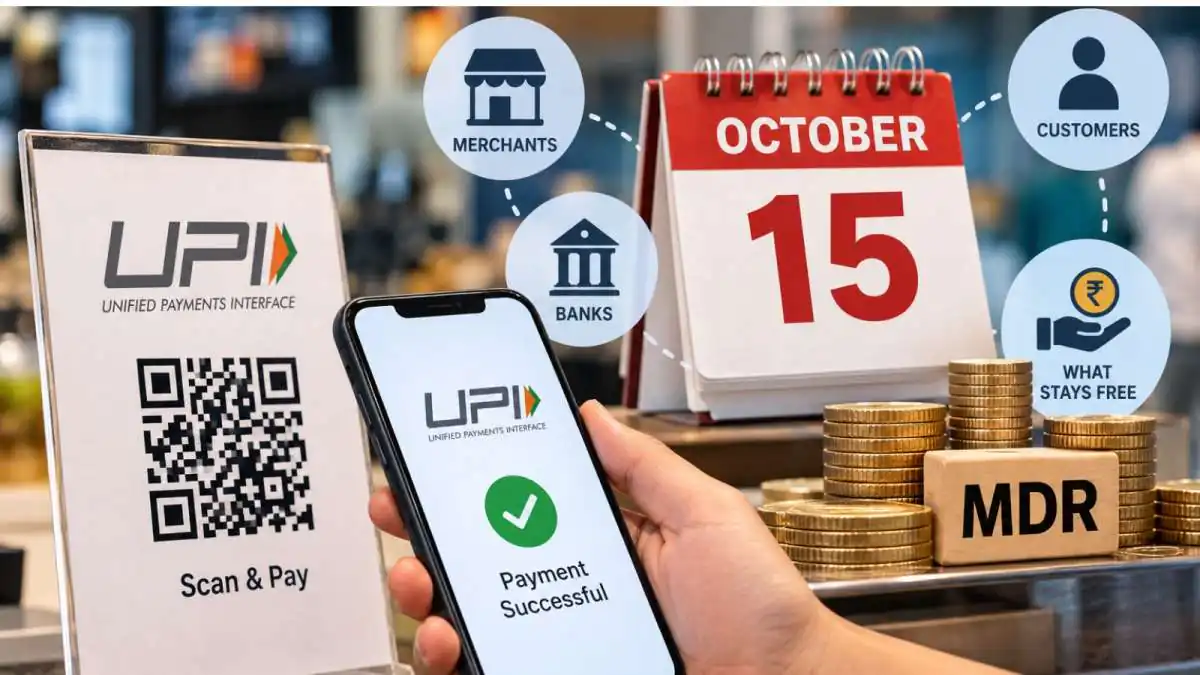
From October 15, a 0.4% Merchant Discount Rate (MDR) will apply to person-to-merchant UPI payments above ₹2,000. The charge will be paid by merchants, not consumers, and will be capped at ₹300 for transactions of ₹75,000 or more.
Payments between individuals, and the vast majority of everyday merchant payments, will remain free. Small merchants receiving under ₹1 lakh a month through UPI QR codes are fully exempt. Merchants also cannot pass these charges on to customers as surcharges or platform fees.
Who Is Actually Affected
The fee targets a small slice of transactions that carries most of the money. Only about 4% of merchant transactions exceeded ₹2,000 in 2025-26, but they accounted for roughly two-thirds of merchant transaction value.
In practice, this means a customer paying a local kirana store or tea stall will see no change. Large retailers, supermarkets and other high-value merchants will absorb the new cost.
Why It Matters: Who Pays for the Pipes?
Running UPI is not free, even if using it has been. Industry estimates put the annual cost of servers, fraud detection and settlement at around ₹20,000 crore. Government subsidies never came close to that. The highest annual outgo was ₹3,631 crore in FY2023-24, and the Budget Estimate for FY2025-26 was just ₹437 crore.
According to the SCMP article, a predictable revenue stream would give banks and payment companies more incentive to invest in cybersecurity, fraud detection and dispute resolution. It would also help build UPI's next phase, which could involve offering credit lines and expanding cross-border transfers.
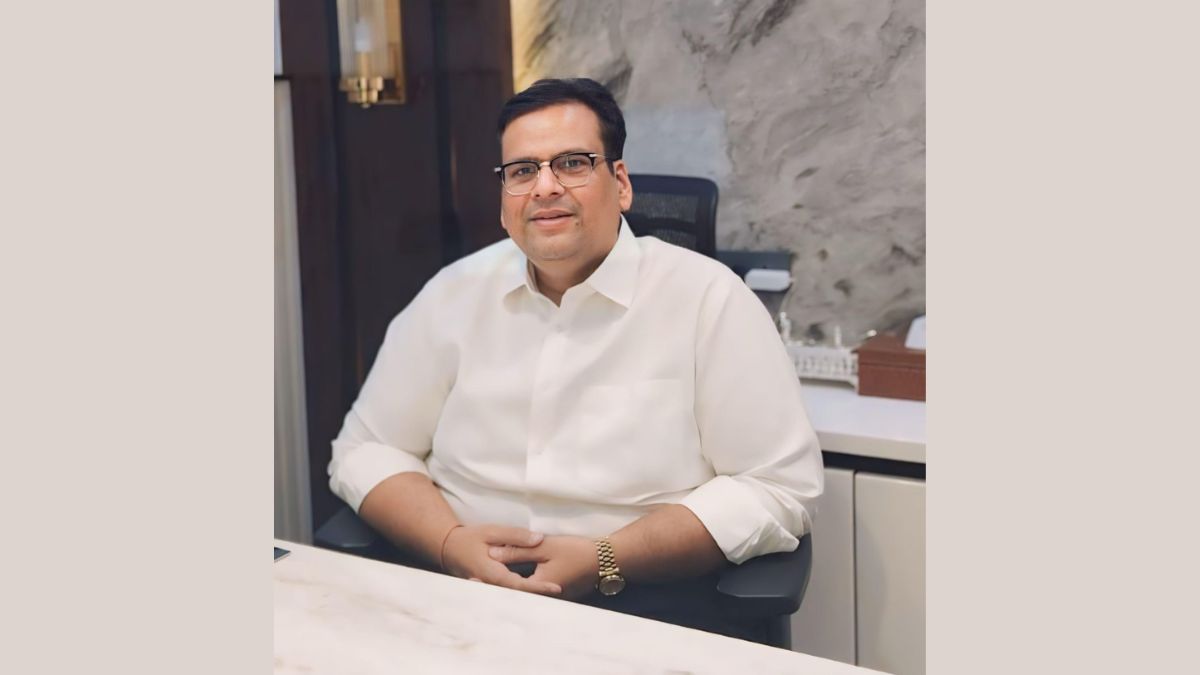
Rohit Arora, co-founder and CEO of fintech firm Biz2Credit, told the publication that some cost recovery from merchants was inevitable after so many years of free use.
A Model Other Countries Are Watching
UPI has also become a template abroad. "Several Asian and Global South systems have studied UPI precisely because it proved you can scale without surrendering the switch to Visa, Mastercard or a foreign boardroom," the article quotes an expert as saying.
Charging merchants is not unusual among those systems. Indonesia has a rate structure based on merchant category and transaction size, while Malaysia's DuitNow merchant charges depend on the bank or payment provider, with waivers in some cases. As the article notes, the underlying issue is the same everywhere: building and running a secure payment network costs money.
UPI Goes Global
UPI now works in 11 countries: Singapore, the UAE, France, Mauritius, Nepal, Bhutan, Qatar, Sri Lanka, Cambodia, Greece and Uzbekistan. Indian tourists, business travellers and students can pay merchants directly from their Indian bank accounts, avoiding foreign exchange markups and reducing reliance on international cards or cash.
What Users and Merchants Should Know
- Consumers: Nothing changes. You pay no fee, whether you send money to a friend or pay a shop.
- Small shops: If your UPI QR receipts stay under ₹1 lakh a month, you remain exempt.
- Larger merchants: Payments above ₹2,000 will carry the 0.4% fee from October 15, so review your billing and reconciliation now.
UPI's first decade was about getting everyone on board, and it worked. Its second decade begins with a harder question: who pays to keep it running. By charging only large merchants on high-value payments, India is trying to fund the system without touching the free, everyday experience that made it succeed.
With inputs from IANS.