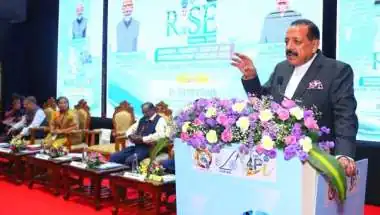
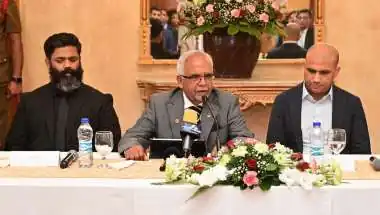
The meeting finalised the expansion of the Institute of Life Sciences, Bhubaneswar, under the Department of Biotechnology, with the Odisha government providing an additional 50 acres of land, according to an official statement.
The expanded capacity is expected to strengthen research in life sciences and biotechnology and support initiatives under the Bio-E3 framework — Biotechnology for Economy, Environment and Employment.
Dr Singh said the Eastern Coastal Region can play a larger role in India’s emerging nuclear and marine roadmap, with Odisha well placed to contribute through coordinated efforts involving Central scientific institutions and the state government. The approach seeks to move from individual institutional initiatives towards a connected ecosystem spanning ocean resources, critical minerals, life sciences, space technology and technology-led economic development.
The minister discussed the roadmap with Odisha’s Cabinet Minister for Science and Technology, Krushna Chandra Patra, who presented a series of proposals relating to the state’s science and technology priorities.
Discussions covered the expansion of marine biotechnology, strengthening of life sciences infrastructure, greater utilisation of Odisha’s coastal and mineral resources, space applications and manufacturing, rare-earth exploration, scientific infrastructure and participation of coastal districts in national marine-environment initiatives.
The Odisha Marine Biotechnology Research and Innovation Corridor (OMBRIC) is being developed as a collaborative platform bringing together leading academic and research institutions in the state. It has already established partnerships with IIT Bhubaneswar, Berhampur University, Fakir Mohan University, NIT Rourkela, IISER Berhampur and the Institute of Life Sciences, Bhubaneswar.
The proposed convergence between marine biotechnology and earth sciences is intended to strengthen scientific understanding and sustainable utilisation of Odisha’s coastal resources. The approach will combine expertise in marine science, earth sciences, biotechnology and mineral-resource research, creating greater scope for joint projects and technology development.
The meeting also explored integrating the state’s space capabilities with ISRO, including the possibility of developing a Space Research and Manufacturing Centre in public-private partnership mode. Such an ecosystem could bring together government institutions, national space agencies, research organisations and industry, the ministry said.