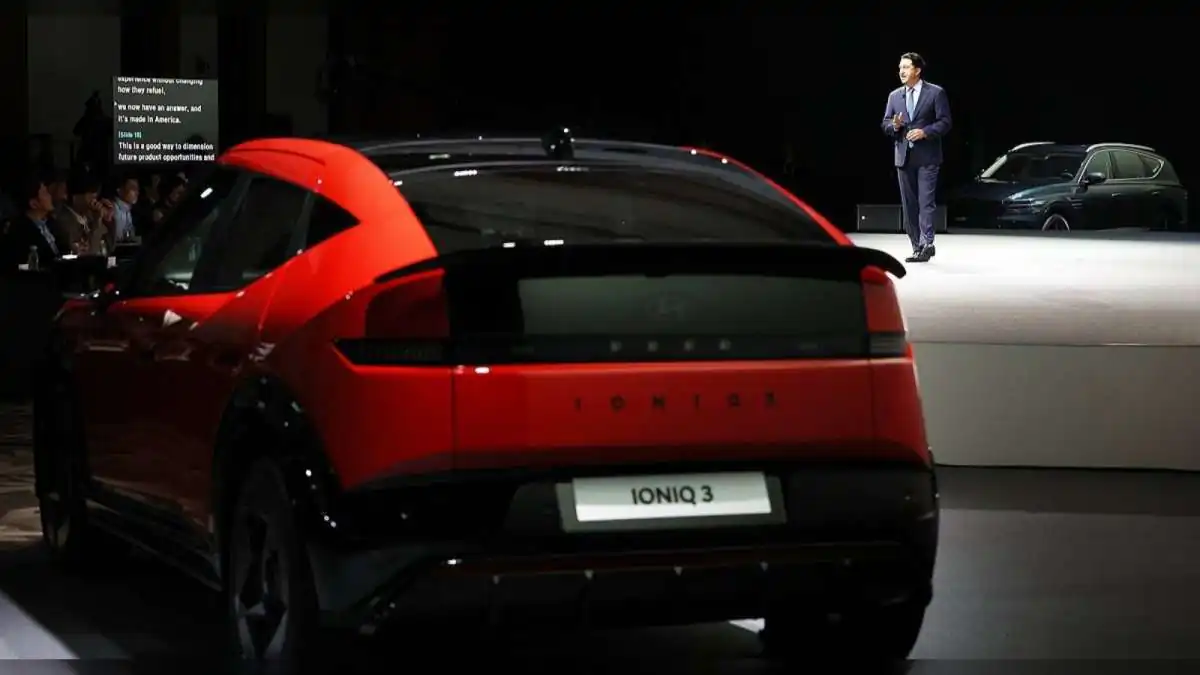
Hyundai Motor has laid out one of its most ambitious multi-year growth blueprints in years. Speaking at its CEO Investor Day event in Seoul, Hyundai Motor CEO Jose Munoz on Wednesday announced that the South Korean automaker plans to expand its overall production capacity by 1.27 million units by 2030, while rolling out more than 100 new and updated models to strengthen its global market position. The announcement is a powerful signal that Hyundai is not merely defending its existing market share — it is preparing to significantly expand it, in a global auto industry that is undergoing structural transformation.
The context behind Hyundai's plan is clear. The global auto industry is in the middle of one of its most intense competitive phases — with the rapid rise of Chinese automakers, the acceleration of electric vehicle transitions, tightening emission norms and the reshaping of global trade dynamics. In this environment, Hyundai's decision to double down on capacity, product breadth and margin expansion is a strong statement of intent — a message that it is preparing for a leaner, sharper and more assertive next phase.
100+ New Models: A Comprehensive Product Push
Hyundai Motor said it plans to introduce scores of brand-new or updated models within the decade, including facelifts, partial redesigns and other variants — with 18 all-new models forming the core of the launch pipeline. That kind of product cadence reflects a modern OEM strategy — where continuous product refreshes, category expansions and variant differentiation drive sustained consumer appeal.
Genesis GV80 Hybrid: The Immediate Marquee Launch
Among the near-term product highlights, the company plans to launch the Genesis GV80 hybrid in South Korea and the United States later this year. That will be followed by an extended-range electric vehicle (EREV) version in the first half of 2027. Genesis, Hyundai's luxury brand, has been building strong momentum globally — and a well-timed hybrid launch reinforces its play in the increasingly important premium hybrid segment.
Tucson: The Volume Anchor Continues to Evolve
Alongside the Genesis push, Hyundai is not neglecting its bestselling volume drivers. The Tucson SUV — one of the company's most consistent global sellers — and its hybrid variants are scheduled for launch in the second half of this year. This reflects a smart dual-brand strategy: aggressive product refresh in the volume segment (Tucson) alongside premium positioning (Genesis GV80 hybrid).
Capacity Expansion: The Numbers That Matter
To support its expanded lineup and rising sales ambitions, Hyundai Motor plans to significantly increase its global production capacity by 2030, up from about 5 million vehicles at present. The breakdown of the 1.27 million-unit capacity expansion is telling in its own right. 500,000 units are planned in North America, 320,000 in India, 200,000 in South Korea, and 250,000 through completely knocked-down (CKD) production. Each of these numbers reflects a specific strategic priority.
India: A Strategic Growth Market
The 320,000-unit capacity addition in India stands out as one of the most consequential parts of Hyundai's global blueprint. India is fast becoming a critical growth market for global automakers — thanks to its large population, expanding middle class, evolving mobility preferences, growing EV interest and increasingly sophisticated manufacturing infrastructure. Hyundai's decision to add such significant capacity in India is a strong endorsement of the country's role in its long-term global strategy.
North America: The Biggest Single Regional Addition
North America gets the largest single regional capacity addition at 500,000 units. This reflects Hyundai's continued conviction in the strategic importance of the US market, particularly as consumers there increasingly gravitate toward SUVs, hybrids and premium models — segments where Hyundai's product strengths are well aligned. Its long-term investment in US-based production also positions it favourably in a policy environment that continues to reward local manufacturing.
The CKD Play: Emerging Markets in Focus
The 250,000-unit capacity expansion via completely knocked-down (CKD) production is a smart strategic move. CKD models allow Hyundai to enter or scale in emerging and lower-margin markets more efficiently, adapting its supply chain and cost structure to local realities. This kind of production model is particularly valuable in fast-growing but price-sensitive regions across Asia, Africa and parts of Latin America.
Sales and Electrification Targets
Even as it expands capacity, Hyundai has maintained its previously announced sales targets. This includes global sales of 5.55 million vehicles by 2030 — and, importantly, raising the share of electrified vehicles to 60 per cent of total global sales by the same year. That electrification target is a decisive commitment to the company's long-term energy transition strategy.
Margin Ambition: A Higher Bar for 2030
One of the more significant announcements from the day was Hyundai's decision to raise its 2030 operating margin target. It now aims for above 9 per cent by 2030, up from the previously projected range of 8-9 per cent. That is a meaningful upward revision — and reflects internal confidence that the combination of product mix improvement, cost discipline and scale advantages can deliver stronger profitability.
The 2026 Guidance Holds Steady
For the current year, Hyundai has maintained its 2026 margin guidance at 6.3-7.3 per cent, despite a challenging business environment marked by US tariffs, geopolitical tensions in the Middle East and intensifying competition with Chinese rivals. Maintaining margin guidance in this environment is itself an important signal of internal stability and operational confidence.
The Hybrid Bet in North America
Perhaps the most consequential strategic call in Hyundai's plan is its bold hybrid push in North America. Jose Munoz identified hybrids as "the biggest opportunity" in the US market. Hyundai plans to launch 10 new hybrid electric vehicle (HEV) models by 2030 in the region, led by the GV80 hybrid, and aims to raise hybrids to 50 per cent of its US sales. That target is a decisive strategic pivot — one that reflects both consumer trends and the maturing energy transition in the largest developed market.
The Hybrid Cost Advantage Play
Alongside product launches, Hyundai plans to cut raw material costs for hybrid vehicles by 20 per cent by 2030. That is a critical operational lever — because hybrid vehicles have historically carried a higher input cost profile than either pure ICE or pure electric vehicles. If Hyundai can execute this cost reduction, it stands to gain both competitive price positioning and healthier per-unit margins on its hybrid range.
Why It Matters: A Multi-Track Strategy for a Complex Era
Hyundai's blueprint reflects a broader industry reality — that the future of the auto industry will not belong to any single powertrain. Instead, the winning global OEMs will be those that can deliver strong ICE portfolios, expanding hybrid ranges, competitive EV models and premium brand extensions all in parallel. Hyundai's plan explicitly acknowledges this multi-track reality.
Industry Impact: Competitive Pressure Intensifies
The Hyundai plan will inevitably raise the competitive bar for other global automakers. Rivals — including established Japanese and European OEMs, as well as fast-scaling Chinese players — will need to reassess their own product launch pipelines, capacity plans, hybrid strategies and margin targets in light of Hyundai's aggressive stance. Expect more high-stakes strategy resets across the industry over the coming quarters.
The China Challenge
The rise of Chinese automakers — with their strong domestic manufacturing scale, aggressive pricing, rapid EV innovation and expanding export ambitions — is one of the most significant competitive backdrops shaping Hyundai's blueprint. By expanding capacity, sharpening product breadth, doubling down on hybrids in the US, and driving cost efficiency, Hyundai is essentially building the operational and strategic muscle it needs to compete effectively against this rising Chinese wave.
Why It Matters: India Enters Hyundai's Global Growth Core
For India specifically, Hyundai's plan is a landmark endorsement. The 320,000-unit capacity addition places India firmly within the company's global growth core — not as a peripheral market, but as an active engine of long-term expansion. That decision is likely to boost investment activity, deepen supplier ecosystem growth, and strengthen job creation across Hyundai's Indian operations and their vendor networks.
The Investor Angle: A Confidence Signal
For investors, Hyundai's blueprint offers several confidence signals. Rising margin targets, expanded product pipeline, aggressive capacity growth, disciplined regional strategy and clear electrification commitments together create a compelling long-term investment case. Given the volatility that continues to shape global auto stocks, the clarity and boldness of Hyundai's plan is likely to be well received by long-term shareholders.
The Consumer Angle: More Choice, More Innovation
For end consumers, the eventual outcome of Hyundai's plan is straightforward — more choice, more innovation, more variants and more competitive value. As the company rolls out over 100 new or updated models by 2030, consumers across geographies stand to benefit from an expanded product menu that spans ICE, hybrid, EV, EREV and premium options tailored to their specific mobility needs.
Why It Matters: Hybrids as a Transitional Backbone
Hyundai's decision to elevate hybrids to a centrepiece of its US strategy carries wider industry significance. Hybrids are increasingly emerging as the pragmatic bridge technology of the energy transition — offering meaningful emissions reductions and better fuel economy without demanding the full infrastructure commitment of EVs. Hyundai's bold hybrid bet is likely to further validate this transitional powertrain's long-term role in global markets.
The Electrified Vision at 60 Per Cent
While hybrids will lead the near-term push, Hyundai's target of raising electrified vehicles to 60 per cent of global sales by 2030 signals a decisive long-term EV commitment as well. The word "electrified" here is important — it covers hybrids, plug-in hybrids, battery electric vehicles and extended-range electric vehicles. That layered electrification approach gives Hyundai flexibility across markets that are transitioning at different speeds.
Industry Impact: The Global CKD Model Gets Renewed Attention
Hyundai's plan to include 250,000 units of CKD capacity in its expansion mix also signals renewed importance for the CKD model in modern global auto strategy. In a world where trade dynamics, tariff structures and localisation pressures are intensifying, CKD assembly offers a flexible, cost-efficient mechanism to grow presence in complex markets. Other global OEMs may increasingly follow suit.
Audience Sentiment: Confidence Meets Curiosity
Reactions to Hyundai's announcement have been broadly positive across industry observers, financial analysts and consumer commentary. The scale of the plan, the clarity of its regional priorities, the boldness of its hybrid strategy and the confidence of its margin ambitions have collectively been welcomed as evidence of a company that is not merely reacting to global change but actively defining its own path through it.
Why It Matters: A Long-Term Bet on Manufacturing Excellence
At its heart, Hyundai's plan is a long-term bet on manufacturing excellence, product innovation and disciplined global execution. It is a plan that recognises the risks of the current environment but chooses to respond with expansion, not retreat. In an era where too many industry players are hedging, Hyundai's willingness to commit clearly and confidently to a bold blueprint is itself an important competitive signal.
The Bigger Picture: A Reshaped Global Auto Order
The next five years are likely to reshape the global automobile industry more profoundly than the previous fifteen combined. Legacy players face intense pressure from Chinese entrants, energy transitions demand new supply chains, consumer expectations continue to evolve rapidly, and geopolitical dynamics reshape trade flows in real time. Hyundai's 2030 blueprint is essentially its strategic answer to this reshaped global order — and its execution over the coming years will be closely watched.
What to Watch: Execution Over the Next 24 Months
Going forward, several execution markers will shape the credibility of Hyundai's blueprint. These include the on-schedule launch of the Genesis GV80 hybrid, the smooth rollout of the Tucson hybrid variants, progress on India capacity build-out, early traction of the North America hybrid push, and continued financial discipline on margins. Each of these near-term milestones will function as an important credibility test for the wider 2030 vision.
The Bottom Line
Hyundai Motor's 2030 blueprint is one of the boldest global auto strategies unveiled in recent memory. With plans to expand production capacity by 1.27 million units, launch more than 100 new or updated models, elevate hybrids to 50 per cent of US sales, raise electrified vehicles to 60 per cent of global sales, and lift its long-term operating margin target above 9 per cent, the South Korean automaker has offered a comprehensive, confident and forward-looking vision. For India, the 320,000-unit capacity commitment is particularly meaningful — placing the country firmly at the heart of Hyundai's next growth chapter. In an era where the global auto industry is being redefined by electrification, geopolitical realignment, Chinese competition and evolving consumer preferences, Hyundai has chosen to respond with a plan built on ambition, discipline and clarity. If executed as envisioned, the coming decade could see Hyundai emerge not just as a stronger player within the existing global auto hierarchy — but as one of the most decisive shapers of the industry's next great chapter. And with today's blueprint firmly on the table, that journey has already officially begun.