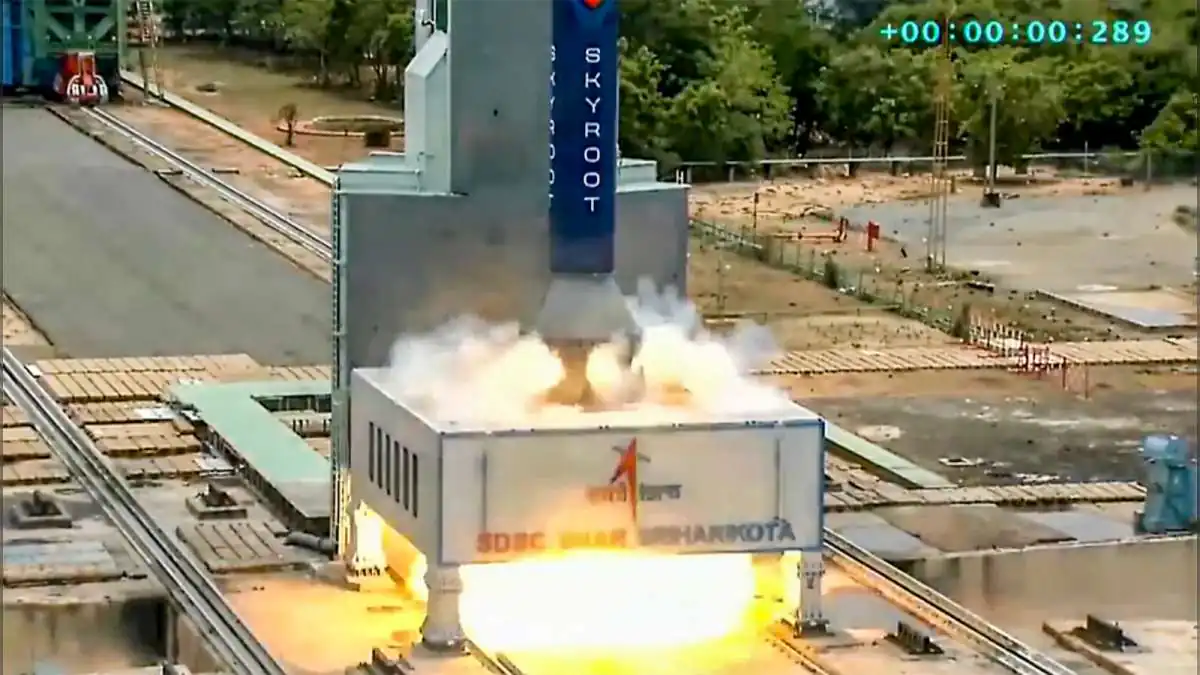
Skyroot Aerospace successfully placed multiple payloads into low Earth orbit with its Vikram-1 rocket. While the report acknowledges that the vehicle is relatively modest in size compared to launch systems operated by competitors in China, Russia or the United States, it stresses that the achievement is nonetheless significant. What matters, the report notes, is not just the size of the launcher — but the fact that a privately built Indian rocket is now delivering payloads into orbit, at a stage of maturity that many other jurisdictions have failed to reach.
Why This Milestone Matters Globally
For decades, the global commercial space race was largely a two-horse contest — the United States and China. That equation, the report argues, no longer holds. "India has now entered it with its own hardware, and Europe has every reason to pay attention," it noted. That single line captures the geopolitical and industrial gravity of what has just happened — an Indian private-sector rocket has entered the global commercial launch conversation as a serious, capable and forward-moving player.
The European Concern: A Capacity Crunch Ahead
The report unpacks in some detail why Europe should be paying particularly close attention to India's rise. Despite increased launches in 2025 following the introduction of Ariane 6 and Vega-C, Europe still commands only a small fraction of a global market overwhelmingly dominated by the United States and China. Even more critically, the European Space Agency (ESA) faces a potential capacity crunch for strategic programmes such as Galileo and Copernicus between 2029 and 2031 — a window during which new requirements could exceed the launch capacity available.
The Startup Gap in Europe
To make matters more urgent, several state-backed private launcher projects across Europe have yet to deliver an operational orbital service. In effect, Europe finds itself at an uncomfortable inflection point — its state programmes are stretched, its private launcher pipeline is still maturing, and its strategic launch needs are set to grow. India, meanwhile, has just proven that its private sector can already deliver payloads to orbit.
The Case for India-Europe Collaboration
The report explicitly advocates for European operators to collaborate with India for certain commercial, university and scientific payloads, as a way to diversify an international launch market that remains heavily dependent on the United States. That framing is significant. It is not just a compliment to India — it is a strategic invitation. It suggests a future in which Indian private launch capacity becomes a genuine tool of European space policy.
India's Long March to This Moment
India's space programme was almost entirely dominated by the state for over half a century. ISRO took the country from its first experiments in the 1960s to developing indigenous launch vehicles, reaching Mars in 2014, and landing near the Moon's south pole with Chandrayaan-3 in 2023. Those decades of public-sector rigour, thrift and mission excellence built the deep technical foundation on which today's private space ecosystem now stands.
The Big Policy Pivot: Opening the Sector in 2020
The transition began in 2020, when the Indian government formally opened the sector to private companies and created IN-SPACe — the Indian National Space Promotion and Authorisation Centre — to facilitate private-sector access to public facilities, testing infrastructure and launch sites. That single decision unlocked years of pent-up entrepreneurial energy, capital appetite and technical talent that had been waiting for the door to open.
The 2023 Space Policy: Structural Clarity
The 2023 Space Policy provided the next major push. It formally separated ISRO's research role, public commercial activity and the emerging private ecosystem — a clean architectural distinction that allowed each layer to operate with clarity, focus and complementary strengths. In global space policy terms, that kind of institutional clarity is precisely what accelerates commercial ecosystems.
A Rapidly Expanding Startup Ecosystem
The results of these reforms have been visible and rapid. India now hosts over 400 space startups, spread across launch vehicles, small satellites, propulsion systems, ground stations, earth observation, space situational awareness and downstream applications. This is no longer a handful of pioneering companies — it is a maturing ecosystem, with layers of specialisation and increasing global relevance.
The $44 Billion Economy Ambition
India's ambition is equally striking. The country is targeting to increase the value of its space economy from around $8.4 billion in 2022 to $44 billion by 2033, including $11 billion in exports. That projection reflects a serious intention to compete not just as a launch service provider, but as a full-stack space economy — spanning hardware, software, services, data and international collaborations.
Why It Matters: The Rise of a New Space Power
India's arrival as a private orbital launch capable nation adds a fourth serious voice to the global commercial space table, alongside the US, China and Russia. In an era where satellite deployment is central to everything from broadband coverage to weather forecasting, from national security to climate monitoring, the availability of another reliable, cost-effective launch partner reshapes the strategic landscape of global space cooperation.
Industry Impact: A New Frontier for Indian Capital
The Skyroot milestone is also a critical signal to Indian and global capital markets. Space, once considered too risky and too niche for mainstream private investment in India, is now emerging as an investable frontier. Every successful mission by a private Indian launcher reduces investor risk perception, opens up follow-on funding rounds, and encourages banks, sovereign funds and family offices to consider space as a strategic asset class.
The Talent Advantage
One of India's most under-appreciated advantages in this shift is talent. Decades of ISRO-driven engineering excellence, deep university-level aerospace programmes, and a growing culture of deep-tech entrepreneurship have created a large, high-quality pool of scientists, engineers, propulsion specialists, materials researchers and mission designers. That talent pipeline is arguably the true strategic moat of India's private space sector.
Audience Sentiment: Pride Meets Expectation
Public sentiment in India around Skyroot's milestone has been unmistakably proud. But it is also increasingly informed and expectations-laden. Indian audiences today do not merely celebrate space milestones symbolically — they follow launch schedules, track startup funding rounds, and understand the economic significance of these developments. That kind of informed public backing is precisely what long-term ecosystems require.
Why It Matters: A Cross-Continent Perspective
For Europe, India's rise offers both a challenge and an opportunity. The challenge is that a new competitor now exists in a market Europe has traditionally sought to occupy. The opportunity is that a strategic partnership with India could genuinely help bridge Europe's coming launch-capacity gap. In a multipolar space age, cooperation may often outweigh competition — particularly among democratic, technology-forward nations.
The Bigger Picture: A New Chapter of Indian Deep-Tech Confidence
Skyroot's Vikram-1 achievement is a landmark, but it is also part of a much larger story unfolding across Indian deep-tech — the story of a country moving decisively from being a consumer of global technology to being a producer, exporter and shaper of it. From semiconductors to AI infrastructure, from clean energy to biotech and now space, India's technological ambition is being visibly reset. Private-sector orbital launch capability is arguably one of the most symbolic and consequential markers of that reset.
The Bottom Line
India's private space sector has just crossed a threshold that Europe has yet to reach — the ability to deliver payloads to orbit through a domestically developed private launcher. That achievement is not just about a single rocket or a single company. It is about the coming of age of an ecosystem — one built on decades of ISRO-led public-sector excellence, catalysed by bold post-2020 reforms, and now driven forward by more than 400 startups pursuing a $44 billion ambition. As the world's commercial space race enters its next phase, India is no longer a curious onlooker; it is a fully credentialed player at the table. And if the recommendations in The European Conservative report are any indication, some of the world's most established space powers may soon be looking to Bengaluru, Hyderabad and Chennai — not just for talent or software, but for launches.
Also Read: Private Orbital Launch Signals India's Space Leap: Jitendra Singh