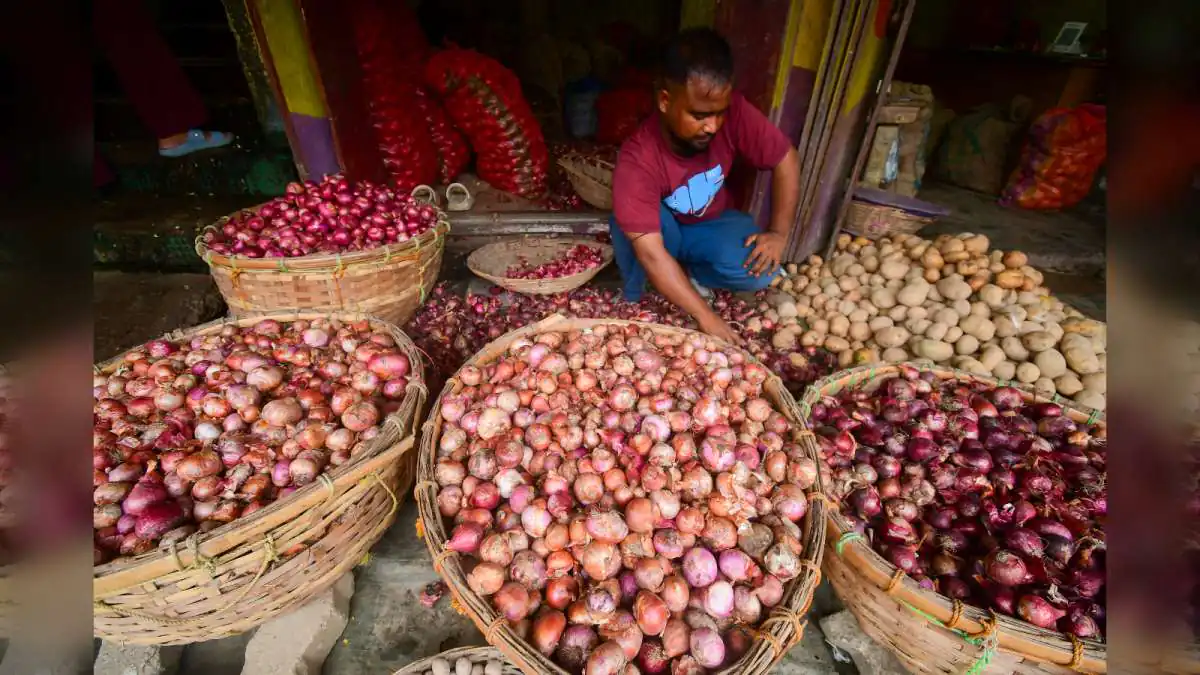
Onions — one of the most emotionally charged food items in the Indian household — are once again at the centre of a major government market intervention. Starting Thursday, the Central government will sell onions directly to consumers at a subsidised price of Rs 35 per kg in the national capital, in a decisive move to cool down surging retail prices that have been hovering in the Rs 55-60 per kg range. In a country where onion prices often shape both kitchen budgets and political sentiment, this intervention is both timely and consequential.
The onions being released into the market are being drawn from a buffer stock of 1.21 lakh tonnes maintained across producing states for 2026. To finance the intervention, the Centre is using its price stabilisation fund — a critical policy instrument specifically designed for moments like this, when market prices spike beyond consumer tolerance. That the government is deploying this fund at this scale reflects the seriousness with which it is treating the current price situation.
The Delivery Channels: NCCF, Nafed and Kendriya Bhandar
The retail intervention will be operationalised through three trusted government-linked channels — Nafed (National Agricultural Cooperative Marketing Federation of India), National Cooperative Consumers' Federation of India (NCCF), and Kendriya Bhandar outlets. Using these three institutions ensures broad geographic reach, established consumer trust and efficient last-mile distribution.
NCCF's Retail Push
NCCF will sell onions directly to consumers through 100 Kendriya Bhandar stores across Delhi and plans to extend the sale through Mother Dairy outlets in the Delhi-NCR region. That combination of Kendriya Bhandar and Mother Dairy essentially creates a broad, high-visibility footprint that is likely to reach large numbers of urban and semi-urban consumers in the coming days.
The 'Kanda Express' Rolls In
Adding a distinct operational drama to the intervention is the 'Kanda Express' — a dedicated freight train transporting 400 tonnes of onions from Nashik in Maharashtra, scheduled to reach Delhi on Thursday. Named for the crop it carries (kanda meaning onion in Marathi), the Kanda Express has become symbolic of the government's willingness to mobilise the full weight of its logistics network to bring price relief to consumers.
NCCF's Buffer and Sourcing
NCCF is holding a buffer stock of 62,000 tonnes of onion and is actively transporting fresh supplies from Nashik to Delhi to meet retail demand. This kind of coordinated buffer-to-market movement is exactly what modern commodity price management looks like when done well — swift, targeted and volume-appropriate.
Nafed's Parallel Movement
Nafed, which is maintaining a buffer of less than 55,000 tonnes of onion, will similarly sell onions in Delhi and other centres, including Kochi and Guwahati. The first such rake, carrying 800 tonnes of onions, has already left Nashik and is en route to Delhi. Combined with NCCF's supply operations, this creates a multi-agency intervention that significantly boosts the volume of subsidised onions reaching consumers.
Beyond Delhi: A Multi-City Rollout
The intervention is not limited to the national capital. Besides Delhi, four other centres — Chennai, Ernakulam, Madurai and Guwahati — are set to receive onion supplies through special freight trains being run for the purpose. That geographic breadth reflects the Centre's intent to address the price situation across multiple demand centres, rather than restricting relief to one metro alone.
The Minister's Roadmap
Consumer Affairs Minister Pralhad Joshi has confirmed that the government intends to roll out the scheme in Kolkata, Bhubaneswar, Hyderabad, Chennai, Bangalore, Ahmedabad, Guwahati, and Raipur in the coming days. This means that within a short time, subsidised Rs 35/kg onion sales are likely to become available in most major Indian metros and Tier-1 cities — a scale of intervention that carries significant national impact.
Market Response: Wholesale Prices Begin to Cool
Even before the retail intervention formally begins, its announcement effect has already started shaping wholesale market sentiment. Prices of onion in the wholesale market in Nashik and Lasalgaon in Maharashtra — India's largest onion trading hubs — have already started to drop following the government's move to intervene. This has lowered inflationary expectations, which have been playing a key role in fuelling the price spiral, a senior official noted.
The Sharp Price Rise: The Numbers Behind the Crisis
The scale of the price increase over the past month underscores exactly why intervention became necessary. The all-India average retail price of onion rose over 28 per cent in a single month — climbing to Rs 44.72 per kg on August 25 from Rs 34.80 per kg on July 25. Compared with a year ago, when onions retailed at Rs 28.67 per kg, prices have jumped 56 per cent. That kind of steep, rapid escalation places pressure not just on consumer wallets but also on inflation expectations across the wider economy.
Why It Matters: Onions Are Emotional in India
Onions occupy a uniquely emotional space in Indian public life. They are used in nearly every household kitchen across income levels, they are integral to countless regional cuisines, and their price fluctuations often trigger disproportionate political and public attention. In simpler terms — when onion prices rise, the entire nation notices. This is precisely why swift government intervention on onion prices tends to be treated as a matter of high policy urgency.
The Consumer Impact
For consumers, a difference between Rs 55-60/kg market rates and Rs 35/kg subsidised rates translates into meaningful monthly household savings, particularly for lower- and middle-income families that consume onions almost every day. In cities where subsidised onions become accessible through NCCF, Kendriya Bhandar and Mother Dairy outlets, the direct financial impact on household kitchen budgets will be immediate and welcome.
The Farmer Angle
While consumer-facing price stability is the immediate goal, careful policy design also protects farmer incomes. The government has been actively purchasing onions from producing regions to build its buffer stock, thereby ensuring that farmers receive fair, reliable off-take even during volatile price cycles. That dual balance — protecting farmers on one end while supporting consumers on the other — is one of the most delicate operational challenges of agricultural price policy.
Industry Impact: A Signal to the Trading Ecosystem
The government intervention also serves as a firm signal to the wider onion trading ecosystem. Traders, wholesalers, aggregators and retailers now know that the Centre is willing and operationally ready to release large buffer volumes into the retail market at short notice. That knowledge alone tends to moderate speculative behaviour — which is why wholesale prices in Nashik and Lasalgaon began softening even before the retail intervention formally launched.
Why It Matters: The Price Stabilisation Fund at Work
The Centre's deployment of the price stabilisation fund for this intervention is worth highlighting. Established specifically to address such sudden commodity price shocks, the fund allows the government to move quickly, decisively and at scale when consumer prices for essential food items rise sharply. Its effective use in the current onion crisis reinforces the strategic value of maintaining such policy instruments for perishable, high-sensitivity commodities.
The Logistics Story: Rail Freight Comes to the Rescue
One of the most operationally interesting elements of the current intervention is the extensive use of special freight trains — including the Kanda Express — to move onions rapidly from producing regions to consumer markets. Indian Railways has consistently proven itself as a reliable partner in such time-sensitive commodity movements, and its role in this intervention will help ensure that volume and speed both remain adequate.
Onion Supply Drivers: A Quick Context
Onion price volatility in India typically stems from a combination of factors — weather-related crop damage, seasonal supply gaps, disruptions in producing states like Maharashtra, storage-related losses in the harvest cycle, and speculative trading in wholesale markets. Occasional export policy changes also contribute to short-term price movements. Understanding this multi-factor context helps explain why proactive government intervention tends to work best when done early and decisively.
Audience Sentiment: Immediate Relief Expected
Consumer sentiment in cities where the subsidised onion sales are being rolled out is expected to shift positively very quickly. For families that have watched their kitchen budgets squeezed by Rs 55-60/kg market prices, the availability of Rs 35/kg onions through nearby Kendriya Bhandar and Mother Dairy outlets will be an immediate, tangible source of relief. In welfare policy, few interventions are more directly felt than those that reduce daily household food expenses.
Why It Matters: Managing Inflation Expectations
A critical, often overlooked dimension of commodity price interventions is their impact on inflation expectations. When consumers, businesses and markets believe that prices of essential items will keep rising, they behave accordingly — which itself further fuels the price rise. By intervening visibly, quickly and at scale, the government helps break that expectations spiral. That, in many ways, is one of the most valuable macroeconomic outcomes of interventions like the current onion move.
The Bigger Picture: A Structural Challenge Remains
While the current intervention is a strong short-term response, the deeper structural challenges of India's onion market remain. These include improving storage infrastructure to reduce post-harvest losses, strengthening cold chain networks, encouraging farmer producer organisations, expanding modern retail penetration and further developing scientific price forecasting frameworks. Every short-term crisis intervention is also, in effect, a reminder that these long-term reforms need continuous attention.
Industry Impact: An Investment Case for Storage and Cold Chain
Every major onion price crisis in India rejuvenates the investment case for improving agricultural storage, cold chain infrastructure and post-harvest logistics. As the government continues to invest in modernising these systems — often in partnership with the private sector — the frequency and intensity of such price shocks can be gradually reduced over time. The current situation is likely to further sharpen focus on these long-term infrastructure priorities.
Why It Matters: A Test of Institutional Coordination
The current intervention is also a real-world test of institutional coordination between multiple central agencies — the Consumer Affairs Ministry, Nafed, NCCF, Kendriya Bhandar, state-level agencies, Indian Railways and last-mile retail partners. When these institutions work together with speed and discipline, the results reach the consumer directly. The current onion intervention offers a strong model of that coordination in action.
The Bigger Picture: Food Inflation Management as Governance
Effectively managing food inflation is one of the most important — and most visible — dimensions of modern economic governance. Every household in the country experiences it daily, and every rise in essential food prices affects both budget and sentiment. Governments that respond quickly, transparently and at scale to such situations tend to earn strong citizen trust — which is precisely why moves like the current Rs 35/kg onion sale carry meaning that extends far beyond the immediate volumes involved.
What to Watch: The Rollout Beyond Delhi
Attention will now turn to the pace at which the intervention expands beyond Delhi to Kolkata, Bhubaneswar, Hyderabad, Chennai, Bangalore, Ahmedabad, Guwahati and Raipur. The speed and smoothness of that expansion will directly shape consumer sentiment across the country. In parallel, market observers will watch how wholesale prices in Nashik and Lasalgaon continue to respond to the ongoing intervention.
The Consumer Playbook
For consumers looking to access the subsidised onions, the practical guidance is straightforward — check nearby Kendriya Bhandar, NCCF outlets and Mother Dairy stores (in Delhi-NCR) for stock availability. As the multi-city rollout proceeds over the coming days, availability will steadily widen, and consumers in target cities can expect visible on-the-ground signage and awareness communication about the intervention.
Why It Matters: A Reminder of Buffer Stock Value
The current intervention also reinforces the strategic value of maintaining large, well-managed buffer stocks of essential commodities. Without such buffer stocks, governments would have far fewer levers to deploy during price shocks. Every rupee invested in building, maintaining and modernising buffer stock infrastructure is essentially an investment in the country's capacity to protect its citizens from sudden essential commodity price crises.
The Bigger Picture: Consumer-Centric Governance in Action
At its heart, the current onion intervention is consumer-centric governance at work. It reflects a clear understanding that government responsibility does not end with policy announcements alone — it extends to real, on-the-ground, everyday impact on household budgets. When a woman shopping for onions at her nearest Kendriya Bhandar can now buy them at Rs 35/kg instead of Rs 55-60/kg, that is exactly what responsive governance is meant to deliver.
The Bottom Line
The Centre's move to sell onions at Rs 35 per kg in Delhi from Thursday — and to progressively roll out the intervention across multiple major cities in the coming days — is a decisive, welcome step in cooling one of India's most sensitive food price situations. Backed by a 1.21 lakh-tonne buffer stock, delivered through Nafed, NCCF and Kendriya Bhandar, powered by the Kanda Express and other special freight trains, and financed by the price stabilisation fund, this intervention brings together the full weight of the Centre's food supply and consumer welfare machinery. With retail prices having jumped over 28 per cent in a single month and 56 per cent year-on-year, the timing of the intervention is not just important — it is essential. And with wholesale markets in Nashik and Lasalgaon already responding positively to the government's announcement, the ripple effect is likely to gather momentum in the days ahead. For Indian households, the message is direct and reassuring — help is on the way, and it is arriving one train, one truck and one subsidised Rs 35/kg onion sack at a time. And in a country where every kitchen carries the story of the onion, that is exactly the kind of governance response that resonates most powerfully with its people.