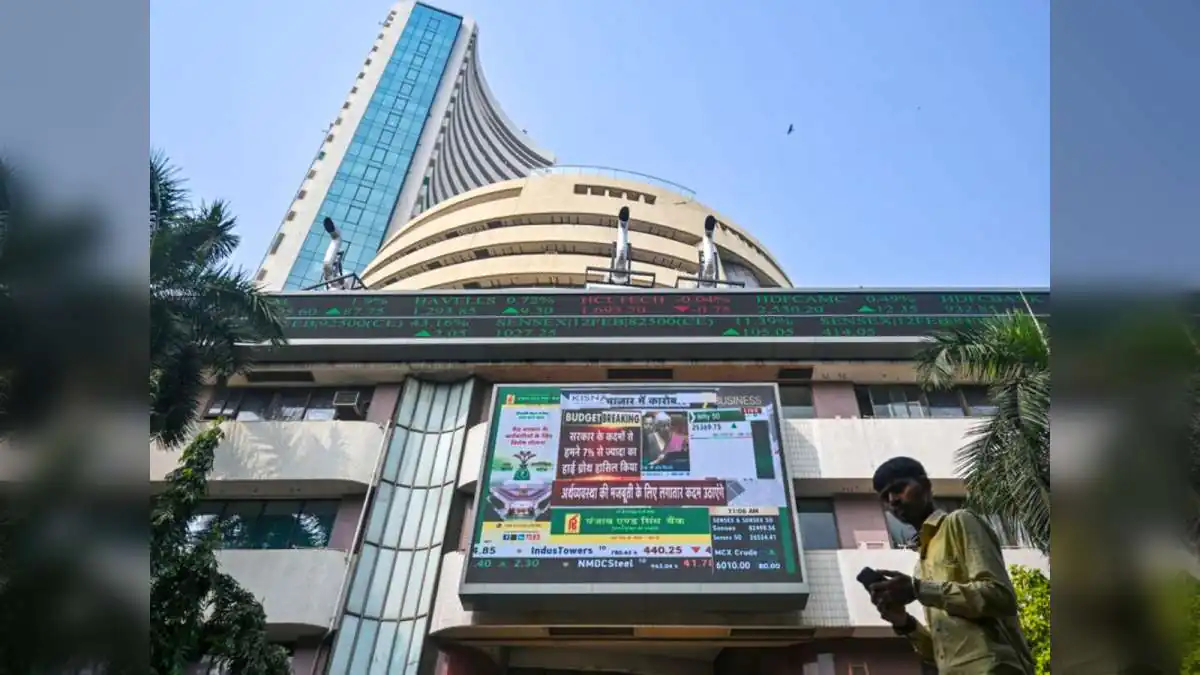
























































The Indian equity benchmarks posted notable losses for the sixth consecutive week, as foreign institutional investor (FII) selling continued and concerns about a prolonged high-rate environment kept investors cautious through the trading week.
Nifty declined 0.22 per cent during the week, though it added 0.33 per cent on the last trading day to close at 23,346. The Sensex, meanwhile, ended down 19 points, or 0.03 per cent, at 74,294, having lost 0.65 per cent over the course of the week.

After a weak start, Indian equities staged a partial recovery later in the week, supported by a retreat in crude oil prices from their recent highs, offering some relief to what had otherwise been a difficult trading period.

Global Policy Decisions Providing Some Relief
"With the US and Japanese policy decisions broadly in line with expectations, easing energy inflation concerns helped temper the inflation premium embedded in sovereign yields, leading to a moderation in yields in the latter part of the week and some relief for equity valuations," an analyst said, pointing to specific global developments that helped ease pressure on markets toward the end of the week.
A Continued Tightening Bias
However, the accompanying policy guidance continued to signal a broader tightening bias across major economies, making a prolonged high-rate environment likely. This underlying signal suggests that even as immediate inflation concerns eased somewhat, the broader monetary policy trajectory among major central banks remains firmly oriented toward sustained higher rates rather than an imminent pivot toward easing.
FII Selling Continues to Weigh on the Rupee
Against this backdrop, persistent FII selling sustained pressure on the rupee and capped the market's rebound, leaving domestic equities lower for the week overall, the analyst added, underscoring how foreign investor outflows have remained a consistent drag on both currency and equity performance in recent weeks.
Mid and Small Caps Outperform
Mid and small-cap stocks outperformed large caps during the week, as investors rotated toward domestically oriented businesses with stronger earnings visibility, healthier order books and sound balance sheets, a pattern suggesting that investors are increasingly favouring companies less exposed to global trade and currency headwinds in the current environment.
Sectoral Performance
Sectorally, healthcare and FMCG attracted buying interest on the back of their defensive earnings profiles and strong linkage to domestic demand, both qualities that tend to become more attractive to investors during periods of global uncertainty and currency pressure.
Realty and Metals Show Strength on Friday
Realty and metals remained among the stronger sectors on Friday specifically, while IT continued to face pressure, with the Nifty IT index declining around 1 per cent, extending a difficult stretch for technology stocks within the broader market.
Pressure on IT and Consumer Durables
Mid and small-cap IT stocks and consumer durables declined over the course of the week, weighed down by concerns over global technology spending and discretionary demand respectively, in an environment shaped by a higher-for-longer interest rate outlook and persistent pricing pressure across these segments.
Nifty's Key Technical Levels
Meanwhile, the 23,000-23,100 zone remains the immediate support area for the Nifty, while the 23,400-23,600 region remains the immediate resistance zone, giving market participants a clear technical range to watch as the index navigates the current environment of mixed global and domestic signals.
What to Watch in the Coming Week
Market participants forecast that domestic credit growth and PMI readings will provide a gauge of underlying economic activity in the week ahead, offering fresh data points to assess the health of the broader domestic economy beyond just market price action. Additionally, US initial jobless claims and commentary from Federal Reserve officials will shape expectations on the rate trajectory and global liquidity conditions, factors likely to remain central to how global and Indian markets move in the sessions ahead.