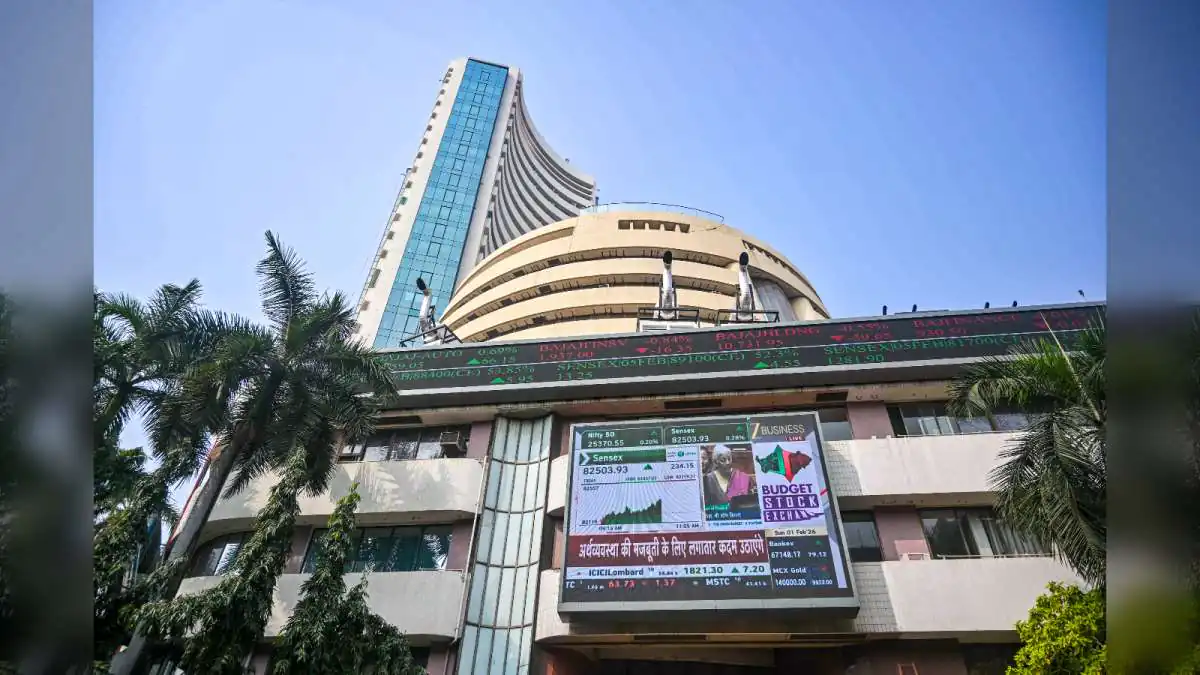
Indian equity markets opened Thursday's session on a cautiously positive note, taking cues from a dip in global crude prices sparked by fresh diplomatic movement in West Asia. As of 9:18 am, the BSE Sensex was up 81 points, or 0.10 per cent, at 77,553, while the NSE Nifty gained 37 points, or 0.16 per cent, to touch 24,425. It was a measured start rather than a decisive one — but for a market navigating inflation nerves and geopolitical crosswinds, the direction mattered as much as the magnitude.
Broader indices moved largely in step with the benchmarks. The Nifty Midcap 100 climbed 0.31 per cent, while the Nifty Smallcap 100 added 0.24 per cent — a signal that risk appetite hadn't retreated. On the sectoral front, all NSE indices traded in the green with the sole exception of Nifty Media, which lagged the pack. Nifty IT emerged as the standout early performer, gaining 0.42 per cent and leading the rally.
The Crude Trigger: Iran-Oman Talks on the Strait of Hormuz
The clearest catalyst for the mood shift came from the oil market. Brent crude eased 0.6 per cent to $87.30 a barrel after Iran confirmed that it was engaged in discussions with Oman to finalise an agreement related to the Strait of Hormuz. Given that the Strait is one of the world's most critical oil chokepoints, any diplomatic softening in the region tends to translate quickly into calmer crude prices — and, by extension, some relief for oil-importing economies like India.
Why It Matters for India
Lower crude prices matter to Indian markets on multiple levels. They ease the country's import bill, reduce inflationary pressure on fuel and downstream sectors, and offer the RBI more room on monetary policy. For a market that has been trading in a tight band, a friendlier oil environment can be the swing factor that shifts sentiment from cautious to constructive.
Analyst View: Cautious, Range-Bound
Market analysts, however, remain measured. "The near-term bias remains cautious and range-bound, with mixed Asian markets and subdued global cues keeping investors watchful. The focus remains on inflation, bond yields and ongoing geopolitical developments, while easing crude prices could provide some support to Indian equities," an analyst noted. On the technical front, the immediate support for Nifty is placed at the 24,000–24,050 zone, while the 24,350–24,400 band remains a key hurdle for the bulls to clear.
Asia Split, Wall Street Mixed
Asian markets offered a mixed backdrop. China's Shanghai index gained 0.63 per cent and Shenzhen advanced 1.17 per cent, while Japan's Nikkei slipped 0.15 per cent and Hong Kong's Hang Seng eased 0.47 per cent. South Korea's Kospi was the standout, climbing 2.01 per cent. Overnight, Wall Street ended mixed-to-lower as investors digested Nvidia's earnings and renewed concerns around US inflation. The Nasdaq lost 0.08 per cent, the S&P 500 shed 0.02 per cent, and the Dow Jones dipped 0.21 per cent.
Institutional Flows: DIIs Do the Heavy Lifting
Institutional activity continued to favour Indian equities. On August 26, foreign institutional investors (FIIs) turned net buyers to the tune of Rs 502 crore. But it was the domestic institutional investors (DIIs) who did the heavier lifting, pumping in Rs 6,425 crore — a pattern that has quietly defined much of the year, with domestic flows repeatedly cushioning the market against foreign selling waves.
The Bigger Picture
Thursday's early moves reinforce a broader theme playing out across Indian markets in 2026: a trading environment where the direction is being set not by domestic triggers alone, but by a delicate mix of crude prices, geopolitical developments in West Asia, and global monetary cues. For now, the Iran-Oman talks have handed D-Street a small breather. Whether that breather turns into a breakout depends on how the next few sessions handle the 24,400 ceiling — and whether crude stays cooperative.
Also Read: Sensex, Nifty Fall Amid Global Uncertainty; IT, FMCG, Auto Drag Markets Lower